

















Hot forging press TMP Voronezh K8542 — 1600 ton
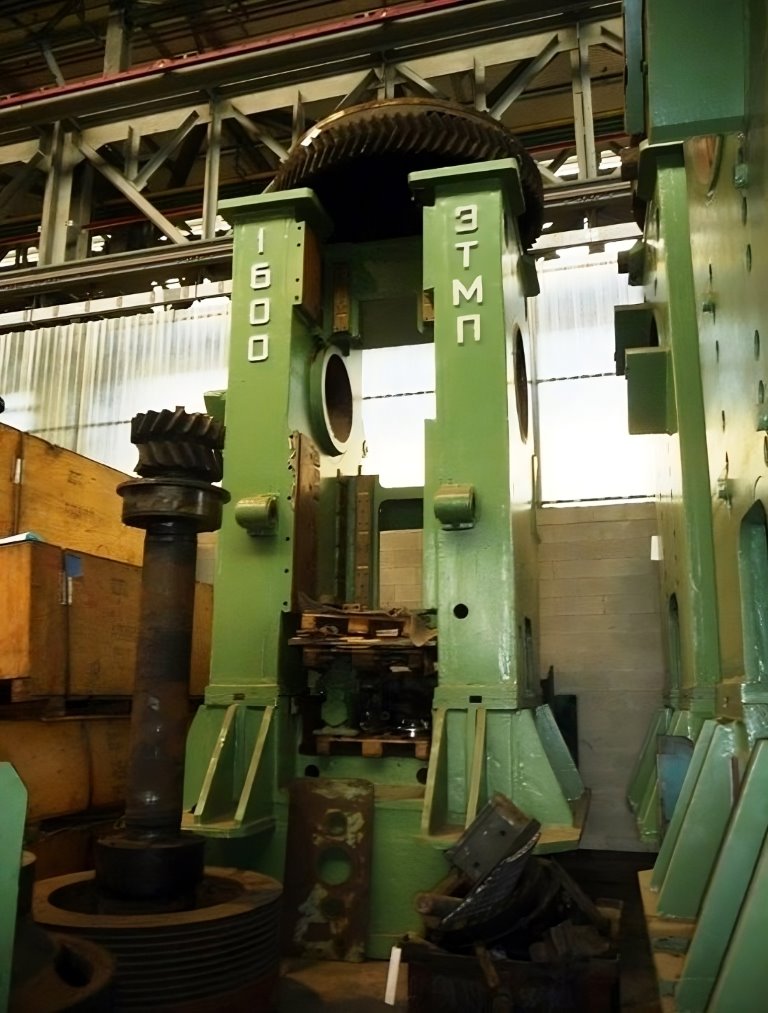
TMP Voronezh K8542 hot forging line - description
Technical specifications TMP Voronezh K8542 (ID:S88037)
| Type | Hot forging line |
|---|---|
| Manufacturer | TMP Voronezh |
| Model | K8542 |
| Year of manufacture | 1967 |
| Maximum force | 1600 ton |
| Slider stroke length | 300 mm |
| SPM | 75 |
| Maximum distance between table and slider (in lower position of slider) | 660 mm |
| Size of adjustment of distance between a table and slider | 10 mm |
| Length of a rod | 920 mm |
| Bed overall dimensions | 940×1200 mm |
| Slider overall dimensions | 860×910 mm |
| The size of lateral windows | |
| Height | 560 mm |
| Width | 600 mm |
| Main motor | 110 kW |
| Press overall dimensions | 5060 x 3940 x 5545 mm |
| Press weigh approx. | 117 tons |
Please note: Specifications are indicative and subject to final confirmation. For current availability and price, as well as photos and technical details, please contact us.
Hot forging line TMP Voronezh - technological processes and operations
| Forging | The process of plastic deformation of metal, in which the workpiece changes shape under the impact of blows or static pressure. During forging, the metal structure is densified, internal inhomogeneities are eliminated, and the mechanical properties of the material are improved. As a result, forged products are distinguished by high strength and reliability when operating under significant loads. Forging is used both for producing finished parts and for preparing workpieces for subsequent stamping. |
|---|---|
| Calibrating | A finishing operation that brings the forging to precise dimensions. The workpiece is placed in a calibration die, where under pressure its surface is leveled and the geometry is brought to the specified tolerances. This process eliminates minor shape distortions left after previous operations. As a result, the part receives stable dimensions and a smooth surface without additional machining. |
| Trimming | When a hot forging leaves the die, flash comes out with it — excess metal squeezed into the gap between the tools. It is removed on a trimming press, where the part passes through a die and the cutting edge shears off everything excess along the contour. This is how the forging gets a clean edge and precise shape, ready for the next stage. |