
Roll forging
Roll forging is a bulk forming operation in which the workpiece is deformed between two rotating rolls with profiled grooves. Unlike closed-die forging, where the shape is created in a single stroke, the metal is redistributed gradually here, passing through several successive calibers. The operation is used to prepare workpieces for subsequent stamping, as well as to manufacture finished parts of elongated shape.
Process essence
Two fundamentally different methods are used in roll forging — longitudinal and transverse (cross-wedge) rolling. They distribute the load differently and force the metal to flow in different ways.
In longitudinal rolling, the workpiece moves perpendicular to the roll axes, which rotate in opposite directions. The metal is drawn into the gap by friction forces and compressed: the thickness decreases while the length and width increase. This is how elongated workpieces with a smooth profile change are produced — for example, for connecting rods and levers.
In transverse (cross-wedge) rolling, the rolls rotate in the same direction, while the workpiece rotates around its own axis and simultaneously moves along the roll axes. The metal is deformed not along the entire length at once, but locally, in the contact zone with the tool. This allows stepped and shaped parts to be formed — shafts, axles, ball pins — in fewer passes and with lower tool load.
The key advantage of both methods is that deformation occurs sequentially, section by section. This reduces tool load and allows processing workpieces of considerable length.
Video
Typical parts and applications
Roll forging is used for workpieces whose length significantly exceeds transverse dimensions:
- Blanks for crankshafts, connecting rods, levers, forks.
- Axles, shafts, rods with variable cross-section.
- Strips for knives and cutting tools.
- Blanks for subsequent closed-die forging.
The operation is widely used in the automotive, machine-building, and tool industries.
Latest listings
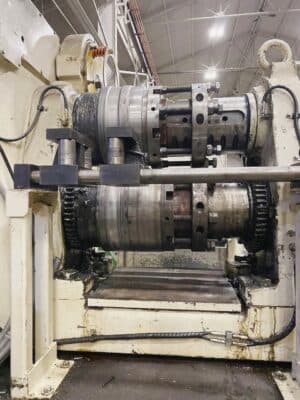
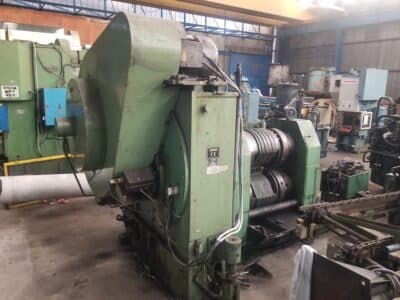
Advantages
- High productivity due to continuous process.
- Metal savings — minimal waste compared to cutting.
- Improved metal structure due to directional flow.
- Ability to process long workpieces.
- Reduced load on subsequent stamping equipment.
Relation to other operations
Roll forging belongs to the bulk metal forming class. The operation is often performed as a preliminary step before closed-die forging — rolling distributes metal along the length, facilitating die filling. It can also be used as an independent operation for producing finished parts.
Frequently asked questions
- Is there hot and cold rolling using forging rolls? Yes, roll forging is performed both hot and cold. Hot rolling is used for large workpieces where it is important to reduce deformation resistance. Cold rolling is used for precise parts with clean surfaces and metal hardening.
- What workpieces are typically processed on forging rolls? Most often, elongated workpieces with variable cross-section are processed — axles, shafts, rods, tool strips. The method is especially advantageous when the workpiece needs to be prepared for subsequent stamping.
- Why is roll forging often used as a preforming operation? Because rolling allows pre-distributing metal along the workpiece length, forming an approximate shape. This facilitates die filling during subsequent closed-die forging and reduces tool wear.
- How does roll forging differ from a pneumatic hammer? In forging rolls, the metal is deformed continuously between rotating rolls, while a pneumatic hammer delivers repeated vertical blows. Rolls provide higher accuracy, less waste, and lower energy consumption.