
Closed-die forging
Closed-die forging is a bulk forming process in which metal is deformed inside a closed die cavity. Unlike open-die forging, the material flow is restricted by the tool walls, allowing forgings with precise geometry and complex relief to be produced. The operation is used in series and mass production where dimensional repeatability and high productivity are essential.
Process essence
The heated workpiece is placed in the lower die half. During the working stroke, the upper half closes with the lower, forming a closed cavity that reproduces the shape of the future part. Under pressure, the metal fills all recesses and contours of the tool, while excess material flows into a special groove — the flash gutter. After forging, the flash is removed in a separate operation.
Filling of the die cavity occurs in one or several blows depending on the complexity of the forging and the equipment capacity. For precise filling of complex shapes, the workpiece is prepared in advance — given an approximate shape in previous passes.
Video
Equipment
Closed-die forging is performed on several types of equipment:
- Mechanical hot forging presses.
- Screw presses with friction or electric drive.
- Hydraulic forging presses.
- Forging hammers with falling parts.
The choice of equipment depends on the forging size, required accuracy, and production volume. Presses provide more precise die filling, while hammers offer greater flexibility when working with large workpieces.
Latest listings
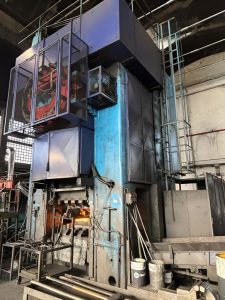
Hot forging press Smeral LZK 4000 — 4000 ton
- Brand:
- Smeral
- Model:
- LZK 4000
- Type:
- Hot forging press
- Parameter:
- 4000 ton
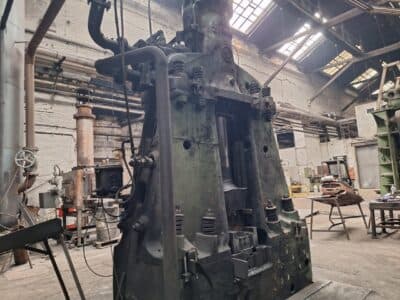
Forging hammer Huta Zygmunt MPM 1000 — 3500 kgm
- Brand:
- Huta Zygmunt
- Model:
- MPM 1000
- Type:
- Forging hammer
- Parameter:
- 3600 kgm
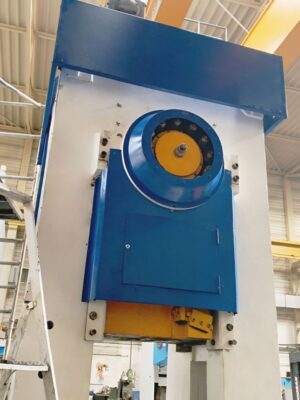
Hot forging press Smeral LKM 1000 — 1000 ton
- Brand:
- Smeral
- Model:
- LKM 1000
- Type:
- Hot forging press
- Parameter:
- 1000 ton
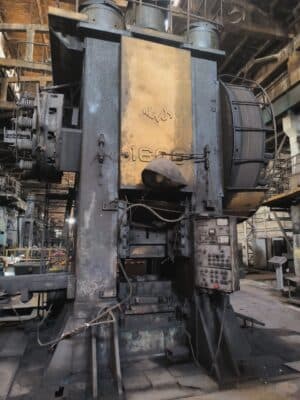
Hot forging press TMP Voronezh KB8042 — 1600 ton
- Brand:
- TMP Voronezh
- Model:
- KB8042
- Type:
- Hot forging press
- Parameter:
- 1600 ton
Differences from open-die forging
In open-die forging, metal flows freely between the dies, and the part shape is created gradually through successive blows and workpiece repositioning. In closed-die forging, the part shape is defined by the die cavity, and the metal is forced to fill it. This difference determines the key advantages of the closed method — geometric accuracy and repeatability from part to part.
Typical parts and applications
Closed-die forging is used in the production of critical parts with strength and accuracy requirements:
- Connecting rods, levers, driveshaft forks.
- Gears, flanges, crosspieces.
- Suspension and steering components.
- Blanks for the aviation and energy industries.
The main industries are automotive, tractor manufacturing, transport engineering, and the oil and gas sector.
Advantages
- High dimensional accuracy and repeatability.
- Ability to produce complex shapes in a single working cycle.
- Metal savings due to minimal allowances.
- High productivity in mass production.
- Improved metal structure due to directional flow.
Relation to other operations
Closed-die forging belongs to the bulk metal forming class. Before forging, the workpiece often undergoes preforming, which facilitates die filling. After forging, trimming and calibration are performed to achieve the specified dimensions.
Frequently asked questions
- What materials are processed? Carbon and alloy steels, titanium alloys, heat-resistant alloys, wrought aluminum alloys.
- What tolerances are achievable? Accuracy depends on the forging size and equipment, but closed-die forging generally provides smaller allowances than open-die forging.
- What is the difference between closed-die and open-die forging? In open-die forging, metal flows freely; in closed-die forging, the shape is defined by the die cavity, providing precise geometry.