
Drop forging
Drop forging is a hot closed-die forging operation in which the workpiece is deformed by the energy of the falling parts of a hammer. The method is suitable both for forging in open dies, where the metal flows freely, and for forging in closed dies, where the metal fills an enclosed cavity. This versatility in tooling type and loading character makes the hammer indispensable in series and medium-series production of forgings weighing from 0.01 to 1000 kg.
Process essence
The heated workpiece is placed in the lower die half. The falling parts of the hammer strike it one or several times, and under the impact load the metal fills the die groove, taking the shape of the future part.
The nature of deformation depends on the die type. In open-die forging, the tool cavity is not enclosed: at the final stage, excess metal is displaced into the flash gutter, forming flash. In closed-die forging, deformation occurs in an enclosed cavity, and the entire volume of metal goes into forming the forging without flash.
Processing is carried out at high temperature, which reduces deformation resistance and increases metal plasticity. The combination of heating and impact loading allows producing complex forgings with good structural refinement.
Video
Why choose a hammer over a press
Forging hammers are chosen over presses due to the dynamic nature of the blow. Presses develop greater force and deform metal through the entire depth, but hammers are indispensable in a number of technological and economic situations.
- Economic advantage in small and medium batches: hammers and their maintenance cost significantly less than presses of comparable forming capability. Hammer dies are structurally simpler and cheaper to manufacture, making small-batch production cost-effective.
- Filling of complex and thin reliefs: at impact, the metal deformation rate is very high — the metal manages to fill thin ribs, sharp corners, and complex die reliefs before the workpiece cools.
- Multiple impacts: if the metal does not fill the shape in one blow, a second, third, and fourth can be applied. A press makes strictly one working stroke, and if the metal does not reach — the part is scrapped.
- Lower requirements for the initial workpiece: the hammer forgives inaccuracies. With uneven heating or scale, the first light blow knocks off the scale and cleans the metal, while subsequent blows form the part. A press under such conditions may jam or break the die.
- More uniform workpiece temperature: contact of metal with the tool lasts thousandths of a second, so the surface does not have time to overcool.
- Versatility: the hammer is equally suitable for both open-die and closed-die forging.
Presses, in turn, provide higher dimensional accuracy and smaller forging draft angles thanks to mechanical ejectors, but are inferior to hammers in the ability to fill deep cavities of complex configuration.
Latest listings
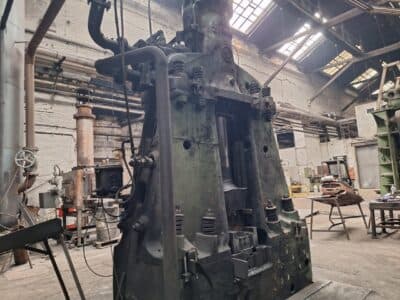
Forging hammer Huta Zygmunt MPM 1000 — 3500 kgm
- Brand:
- Huta Zygmunt
- Model:
- MPM 1000
- Type:
- Forging hammer
- Parameter:
- 3600 kgm
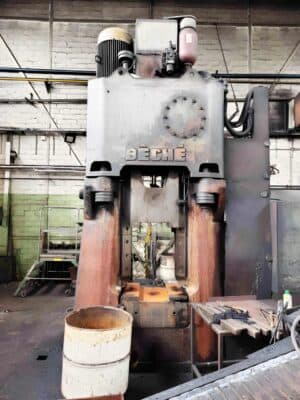
Hydraulic forging hammer Beche KGH 1.6 — 16 kJ
- Brand:
- Beche
- Model:
- KGH 1.6
- Type:
- Hydraulic forging hammer
- Parameter:
- 16 kJ
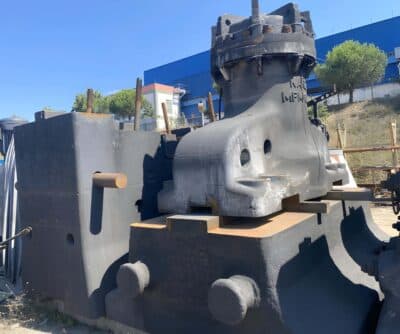
Forging hammer Huta Zygmunt MPM 16000 — 17500 kgm
- Brand:
- Huta Zygmunt
- Model:
- MPM 16000
- Type:
- Forging hammer
- Parameter:
- 17500 kgm
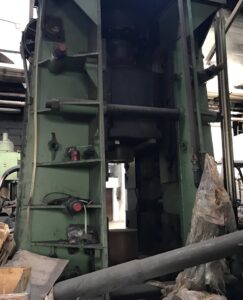
Counterblow forging hammer Beche DGH 16 — 16 ton
- Brand:
- Beche
- Model:
- DGH 16
- Type:
- Counterblow forging hammer
- Parameter:
- 16 ton
Typical parts and applications
Drop forging is used for parts with increased requirements for strength and reliability:
- Crankshafts and camshafts, connecting rods.
- Suspension and steering components.
- Fasteners, tools, wrenches.
- Parts for the aviation, energy, and oil and gas industries.
Advantages
- High strength and impact toughness of finished parts.
- Improved metal structure due to directional flow.
- Absence of internal defects — voids and porosity.
- Ability to work with both open and closed dies.
- Metal savings compared to machining from a solid block.
- Ability to process a wide range of steels and alloys.
Relation to other operations
Drop forging belongs to the bulk metal forming class. Before forging, the workpiece may undergo preforming, and after — trimming and calibration to achieve precise dimensions.
Frequently asked questions
- How does drop forging differ from press forging? The hammer deforms metal with a series of concentrated blows, the press with smoothly increasing force. The hammer fills complex cavities better, the press provides more precise dimensions and smaller draft angles.
- Can a hammer be used for closed-die forging? Yes, the hammer is used for both open-die and closed-die forging. The choice depends on the part configuration and accuracy requirements.
- What materials are processed? Carbon and alloy steels, titanium and heat-resistant alloys, aluminum alloys.
- Why is forging carried out in the hot state? Heating reduces deformation resistance and increases metal plasticity, allowing complex cavities to be filled without fracture.