
Trimming
Trimming is an operation that completes the hot closed-die forging process. When the forging leaves the die, flash remains along its contour — excess metal squeezed into the gap between the tool halves. Without removing this excess, the part cannot be considered finished, so trimming is a mandatory stage of the technological chain.
Process essence
The forging is placed on a trimming die that follows the contour of the part. During the press stroke, the forging is pushed through the die, and the cutting edge shears the flash along the entire perimeter. It is important that trimming is performed immediately after forging, while the metal still retains high temperature — in the hot state, shear resistance is significantly lower and the edge is cleaner.
For complex forgings, trimming may be performed in several stages if the part design does not allow removing all flash in a single stroke. In such cases, progressive dies or separate operations for different sections are used.
Video
Equipment
Trimming is performed on specialized trimming presses that work in tandem with the main forging equipment:
- Mechanical trimming presses.
- Hydraulic trimming presses.
- Universal presses with trimming dies.
- Automatic lines combining forging and trimming.
The choice of press depends on the forging size, flash thickness, and required productivity. Large parts require presses with long stroke and high force, while small parts use high-speed mechanical machines.
Latest listings
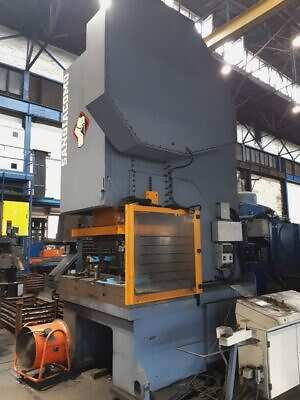
Mechanical press Sangiacomo T.450 RCE — 450 ton
- Brand:
- Sangiacomo
- Model:
- T.450 RCE
- Type:
- C-type press
- Parameter:
- 450 ton
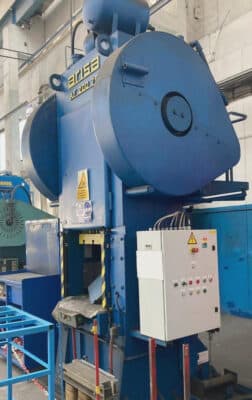
Mechanical press Arisa AF 200 75 — 200 ton
- Brand:
- Arisa
- Model:
- AF 200 75
- Type:
- Trimming press
- Parameter:
- 200 ton
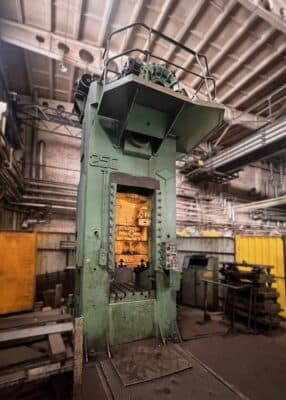
Trimming press TMP Voronezh KA2534 — 250 ton
- Brand:
- TMP Voronezh
- Model:
- KA2534
- Type:
- Trimming press
- Parameter:
- 250 ton
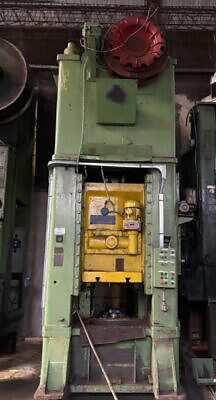
Trimming press TMP Voronezh K2535 — 315 ton
- Brand:
- TMP Voronezh
- Model:
- K2535
- Type:
- Trimming press
- Parameter:
- 315 ton
Types of trimming
Several types of trimming are distinguished depending on flash location and forging design:
- External flash trimming — removal of excess along the outer contour of the part.
- Internal web punching — removal of metal from holes and cavities.
- Combined trimming — simultaneous removal of external flash and internal webs.
Each type requires its own die design and equipment setup.
Typical parts and applications
Trimming is applied to all forgings produced by hot closed-die forging:
- Connecting rods, levers, forks.
- Gears, flanges, crosspieces.
- Suspension and steering components.
- Large forgings for the energy and oil and gas industries.
Advantages
- Obtaining a precise part contour without additional machining.
- High productivity when working in automatic lines.
- Reduced load on subsequent machining.
- Possibility of recycling removed flash.
Relation to other operations
Trimming belongs to the bulk metal forming class. The operation is performed immediately after forging and is often combined with hole punching and calibration. After trimming, the forging may undergo heat treatment and descaling.
Frequently asked questions
- Why is trimming performed in the hot state? Hot metal has lower shear resistance, which reduces tool load and improves edge quality.
- What materials are processed? All steels and alloys suitable for hot forging, including alloyed, heat-resistant, and titanium alloys.
- Can flash be trimmed on the same press where forging is performed? Combined dies are used for this purpose, but trimming is usually separated into its own operation.