
Upsetting
Upsetting is one of the basic operations of bulk metal forming, allowing parts with a local increase in cross-section to be produced. The essence of the process is that the workpiece is compressed in the axial direction, and the metal is redistributed sideways, filling the die cavity. This is how thickenings, flanges, collars, and stepped transitions are formed on rod-type parts.
Process essence
Upsetting is based on the plastic flow of metal under compression. The workpiece is clamped in a split die, after which the free end is subjected to axial compression by a punch. Under the applied force, the metal flows radially and fills the forming cavity of the tool. As a result, a part with the specified thickening is obtained, while the mass of the workpiece remains unchanged.
One of the key limitations of the operation is the ratio of the upset length to the diameter of the original workpiece. In cold upsetting, a section of no more than 2.5–3 diameters is usually upset in one pass. If a larger thickening is required, the process is divided into several successive passes with intermediate forming.
Video
Equipment
Upsetting is performed on several types of equipment:
- Horizontal forging machines with a split die.
- Single-position and multi-position upsetting presses.
- Cold heading machines for mass production of fasteners.
- Hot forging presses.
The choice of equipment depends on the workpiece size, required accuracy, and production volume. Cold heading machines provide high speed and minimal tolerances, while hot upsetting presses allow processing of large-section workpieces.
Latest listings
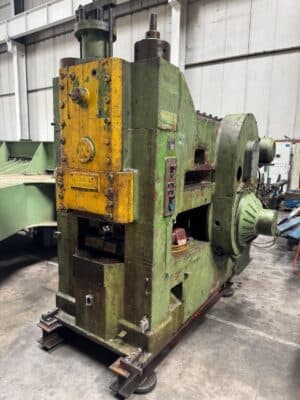
Forging upsetter Kieserling SKH 200 — 200 ton
- Brand:
- Kieserling
- Model:
- SKH 200
- Type:
- Forging upsetter
- Parameter:
- 200 ton
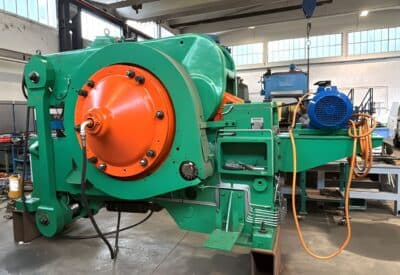
Forging upsetter Eumuco SMZ 20 — 200 ton
- Brand:
- Eumuco
- Model:
- SMZ 20
- Type:
- Forging upsetter
- Parameter:
- 200 ton
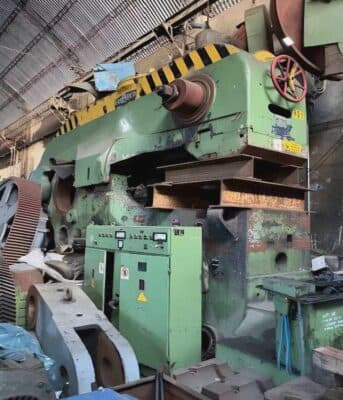
Forging upsetter Eumuco SMZ 160 — 1600 ton
- Brand:
- Eumuco
- Model:
- SMZ 160
- Type:
- Forging upsetter
- Parameter:
- 1600 ton
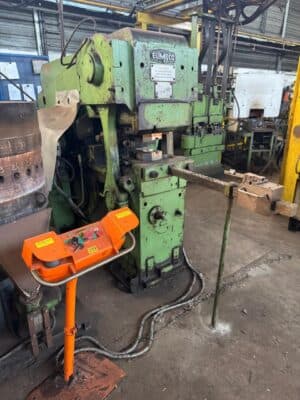
Forging upsetter Eumuco SMZE 8 — 80 ton
- Brand:
- Eumuco
- Model:
- SMZE 8
- Type:
- Forging upsetter
- Parameter:
- 80 ton
Hot and cold upsetting
Upsetting can be performed in both cold and hot states. Each option has its own features.
- Cold upsetting: high accuracy, clean surface, metal hardening due to work hardening, minimal waste.
- Hot upsetting: lower deformation resistance, ability to process large workpieces, need to account for scale and subsequent trimming.
Cold upsetting is mainly used for the production of fasteners and precision parts, while hot upsetting is used for complex-shaped forgings and large flanged products.
Typical parts and applications
Upsetting is widely used in industry for manufacturing parts with thickenings:
- Bolts, screws, rivets, studs.
- Shafts with stepped transitions.
- Flanges, collars, ring thickenings.
- Blanks for subsequent machining.
The main application industries are automotive, fastener production, mechanical engineering, and oil and gas equipment.
Advantages
- Material savings due to redistribution rather than metal removal.
- Improved metal structure due to plastic flow.
- High productivity in series and mass production.
- Ability to produce precise blanks with minimal machining allowance.
Relation to other operations
Upsetting belongs to the Bulk metal forming class. The operation is often performed in conjunction with Heading — forming a head at the end of a rod-type workpiece. Upsetting can also be followed by trimming (Trimming) and calibration (Calibrating) to achieve precise dimensions.
Frequently asked questions
- What is the difference between upsetting and compression? Compression is a general concept of axial compression of a workpiece, while upsetting is a special case with a local increase in cross-section.
- What materials are processed? Carbon and alloy steels, aluminum and copper alloys, stainless steels.
- What tolerances are achievable in cold upsetting? Accuracy depends on the equipment, but it allows obtaining blanks with minimal allowance for machining.