


















Hydraulic press SMG HPU 1000-1800/1150 — 1000 ton

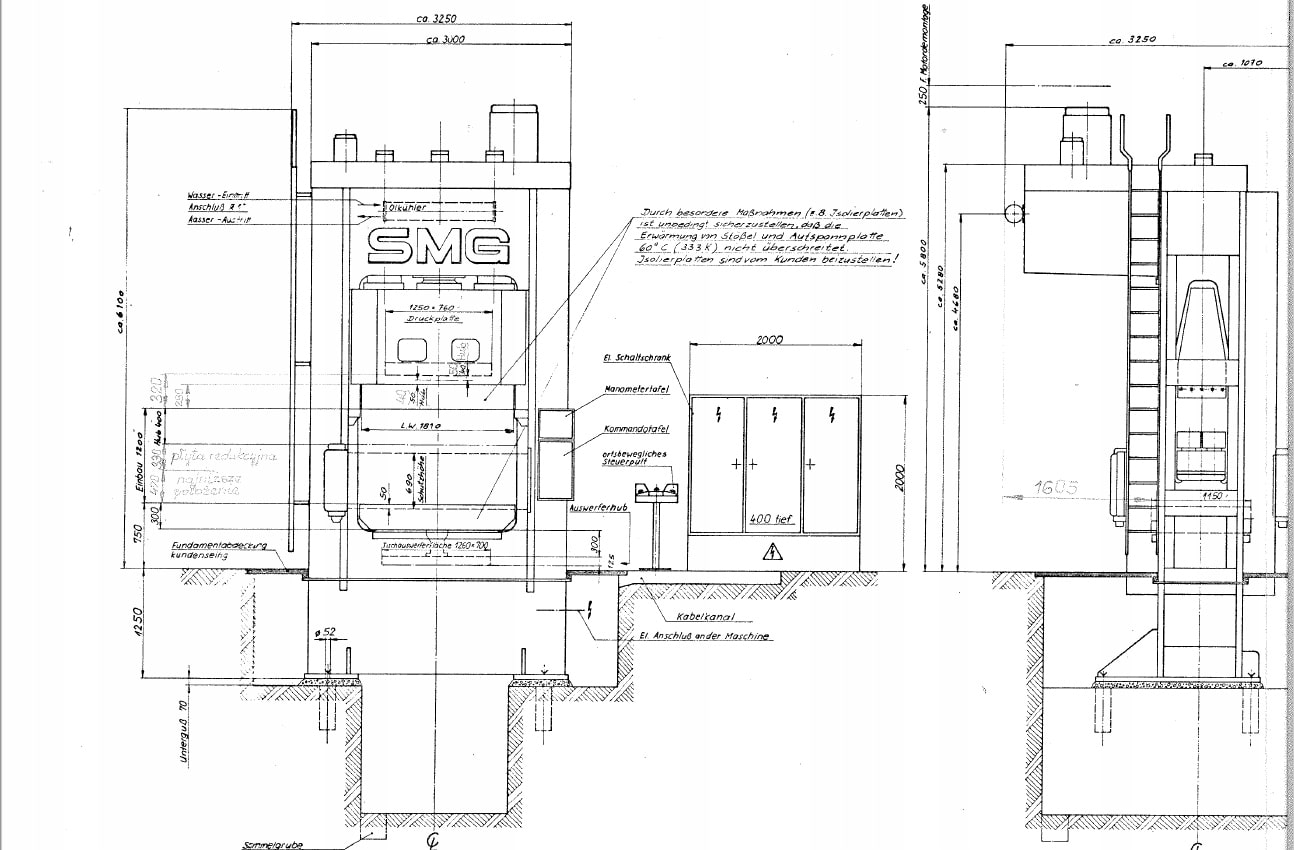


SMG HPU 1000-1800/1150 hydraulic press - description
Technical specifications SMG HPU 1000-1800/1150 (ID:75874)
| Type | Hydraulic press |
|---|---|
| Manufacturer | SMG |
| Model | HPU 1000-1800/1150 |
| Year of construction | 1982 |
| Total force | 1000 ton |
| Slide retraction force | 590 kN |
| Ram stroke | 400 mm |
| Distance table / ram | 1200 mm |
| Ram surface (width / depth) | 1800/1150 mm |
| Clear width between the uprights | 1810 mm |
| Table clamping surface (width / depth) | 1800/1150 mm |
| Table ejector force | 800 kN |
| Table ejector stroke | 125 mm |
| Table ejector surface (width / depth) | 1260/700 mm |
| Drive power | 90 kW |
| Pump output | 360/1500 l/min, U/min |
| Rapid speed (down / up) | 400/244 mm/s |
| V max . | 16/23, 5/47 mm/s |
| V nominal pressure | 8.5/13/25 mm/s |
| Ram — ejector hydr. (number / stroke) | 1 x 50/2000 mm/kN |
| Plunger pad area (width / depth) | 1250/760 mm |
Please note: Specifications are indicative and subject to final confirmation. For current availability and price, as well as photos and technical details, please contact us.
Hydraulic press SMG - technological processes and operations
| Press fitting | Press fitting is an assembly operation in which one part is inserted into another under the force of a press. The connection is achieved through interference fit, where the mating surfaces are held together by friction. The process provides strong and precise joints without the use of heat or fasteners. Used in the assembly of bushings, bearings, pins, and other components requiring a tight fit. |
|---|---|
| Sheet stamping | Sheet stamping is a class of operations for forming parts from sheet material using dies. The workpiece is deformed in the tool without significant change in thickness, acquiring the specified shape. This group includes blanking, punching, bending, drawing, and other processes performed on presses. Sheet stamping is the foundation of mass production of body panels, housings, and other thin metal parts. |
| Drawing | Drawing turns a flat blank into a hollow product. The sheet is clamped at the edges while the tool presses the central part, forcing the metal to flow into the die cavity and form walls. This is how cups, caps, housings, and other parts with one open side are produced. |
| Deep drawing | A sheet blank is drawn into the die to a depth significantly exceeding its transverse dimension. The process is carried out in stages, with intermediate transitions, to avoid tears and wrinkles. At each stage, the metal is gradually redistributed, increasing the depth of the part while maintaining wall thickness. This method produces hollow products of complex shape — cylinders, shells, and housings. |
| Bending | Bending gives a sheet blank an angle or curvature. The metal is bent in the die under the force of the press: the outer layers stretch, the inner layers compress, and the middle retains its original length. The operation allows producing parts with the specified geometry without changing the material thickness. |